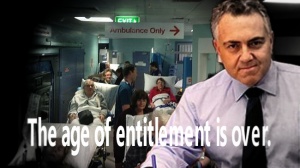
Background: Herald Sun, Frankston Hospital December ’13
My impression in the lead-up to Hockey’s budget was that we would be damned if we did, and damned if we didn’t. Damned if we were ill or disabled, damned if we were unemployed, and most definitely damned should we ever have the temerity to become ‘a burden on society’, and get old.
And it seems that for none else, other than the Gina types of our society, that this has been confirmed.
There is not much point in once again noting that Abbott promised no surprises, no new taxes, no increased taxes, no cuts to education, no cuts to health. I would suspect that for the vast majority of us, that given Abbott’s political record that the surprise would have been if he had kept his word. Making promises is nothing but ‘clever politics’, and anyway you cannot believe anything said in the heat of a debate – nor at any other time, it seems. Tony Abbott promised to restore trust in government, then quickly discarded the notion.
As written by Robert Simms for The Drum:
Tony Abbott is a pathological liar who has lost the respect of the Australian people. He leads a beleaguered government, held ransom by extremists in the Senate. His government is illegitimate. He must resign and end our collective misery!
Simms was noting the irony of the hate campaign run incessantly by Abbott during his term as leader of the opposition. Surely it is now time for Abbott and barrackers to apply the same standards to themselves. But of course not.
Just prior to the election, the Herald Sun and without exception, all of the Murdoch stable gushed effusive praise. Ding, dong, the witch is dead, and the wordy nerd come power-tripper gone with her. All Hail the prince!
TONY Abbott stands ready today to become Australia’s new prime minister with a set of economic and social policies to take the nation into a safe and assured future.
He has not wavered from the task of building a disciplined and cohesive Coalition team . . . In doing so he has proved himself a conviction politician . . . He has proved himself a man of principle.
Labor has lost its way as well as its heart. It has chosen to stoke class war to gain political advantage.
Not only is this un-Australian, it is also a betrayal of modern Labor.
The Herald Sun believes Mr Abbott should be given the opportunity tomorrow to restore Australia for Australians.
I hope that the writer of the above editorial is now equally as damning of the obvious the ‘class war’, the restructure of our society with the well off being deprived of a small slice of their massive pie while the poor will be grubbing around in the gutter.
But now, and even before Hockey’s horror budget saw the light of day, (again from Simms):
This growing sense of hypocrisy is reinforced by the contradictory political persona the Prime Minister has crafted for himself. Indeed, six months after his election, many voters would struggle to articulate precisely what he stands for.
We have a budget emergency, yet the Government can still find billions of dollars for fighter jets. Abbott supported Gonski and the NDIS before the election, yet was eager to dump them after. He promised no new taxes, yet wants to charge for visits to the doctor. Even his Paid Parental Leave Scheme has been watered down, suggesting that if it was Abbott’s signature policy, his autograph was forged.
From Ross Gittins:
If you thought a man who could promise ”no surprises, no excuses” was a man who could be trusted to keep his word, more fool you.
Any experienced voter who didn’t foresee that changing the government would mean this year’s budget was a stinker, isn’t paying enough attention.
Here are but one example of the ideological agenda being presented to us, and for no one’s delectation except those whose beliefs run to right-wing extremism. As someone tweeted: Welcome to the United States of Australia.
April 2014 – “. . .the government moves to dismantle Labor’s GP super-clinic program by trying to claw back money from centres that are yet to be built. GP super-clinics with longer opening hours, more staff and broad medical services were a major plank of Labor’s health policy in government, with $650 million earmarked for 60 clinics. Funding has been suspended to three clinics which are yet to be built – in Darwin, Rockingham in Western Australia and Brisbane”.
December 2013 – “NSW will miss out on more than $150 million in funding for vital health services that has been cut by the federal government. This is bad news for public hospital patients. People living in western Sydney will be hardest hit by the cuts, with Westmead Hospital losing $100 million over three years. The Children’s Medical Research Institute and the Westmead Millennium Institute will also lose tens of millions of dollars . . .”.
And now in addition to this and a whole lot more which is likely to have passed under the radar, there is:
Billions of dollars will be slashed from already-strained public hospital budgets under plans that could lead to huge increases in waiting times for surgery and emergency treatment.
The Commonwealth will for the first time allow the states to charge patients for public hospital treatment, partly to deter people from circumventing a $7 fee for GP visits by going to the emergency department, despite strong opposition from doctors who say hospitals are not placed to deal with the administrative burden.
This seems to an ongoing theme of the Abbott/Credlin/Hockey government, that all should be government via ‘deterrence’. The excuse for imposing a $7 fee has been that this will act as a deterrence: “. . . imposing more user charges in health in order to deter overuse”. But surely it is the medical practitioner’s role to decide on the level of care required by each patient, and not the role of governments to decide what is and what is not ‘overuse’.
The previously-mooted $7 fee will apply to GP visits, diagnostic imaging such as X-rays and pathology services such as blood tests. Concessional patients and children under 16 years will pay the fee only for the first 10 services they use each calendar year. The government will cut its contribution to the cost of those services by the same amount, saving it $3.5 billion over five years. Part of the new fee will go towards a new $20 billion medical research fund.
Presumably, which will also act as ‘a deterrence’ to those individuals who go groveling at their GP’s feet, begging for ‘unnecessary’ items (which therefore might be ‘overused’), such as X-rays and blood tests.
Doctors have discretion to choose who pays the fee, but there is a catch.
If GPs choose not to charge a patient, they won’t receive their $6.20 bulk billing consultation payment from the government.
Anyone for blackmail?
Patients will also pay more for prescription medications, with the general patient contribution rising next year by $5, while the contribution by concessional patients will rise by 80¢.
This may not seem like much, but here is a true indication of how means and just plain nasty this government is: “. . .the cost of the diabetes drug insulin will rise from $37.70 to $42.70. But if you’re a concession card holder, you’re in luck. Instead of the $5, card holders will pay an extra cost of just $0.80.
For instance, if you are a concession card holder and you need to buy Dabrafenib, a treatment for malignant skin cancers, you would pay $6.90 instead of the previous price $6.10″.
That’s right. If you are a pensioner with cancer, this government is going to extract 80 cents out of you. Mean, petty and just plain nasty.
Consumers Health Forum chief executive Adam Stankevicius said the budget spelled the end of universal access to primary care under Medicare.
“It’s very bad news for consumers, particularly the elderly and those with chronic disease.”
The president of the Australasian College for Emergency Medicine, Anthony Cross, said the introduction of the fee would lead to more people seeking treatment in emergency departments for problems more appropriately treated by GPs, and it would be ”almost impossible” for hospitals to decide which patients should be charged for treatment.
Just a question, and this is again from news.com:
New rules mean you’re going to have to wait six months if you want to receive Newstart or Youth Allowance and you’ve just left school or are a new jobseeker.
After that six month period, the government will provide you with six months’ worth of income support — although you’ll have to participate in Work for the Dole at 25 hours a week.
If you’re still unemployed after the first 12 months, the government will not support you for the next six months — except in the form of wage subsidies to employers as an incentive to hire you.
The tedious cycle of six months on, six months off continues.
How are people meant to survive if they are unemployed and will not receive any form of assistance for six months? Beg on the streets? In typical Abbott/Hockey style the practicalities of things such as survival seem to escape them in their zeal to enforce this thing now known as ‘a deterrence’.







 Café Whispers